
How Can Thailand Turn Climate Pressure into a Competitive Advantage?
Climate change is no longer solely an environmental issue; it is rapidly transforming the rules of the global economy, investment, and trade. This encompasses everything from carbon benchmarks, product origin verification, and supply chain disclosures to sustainability regulations for products, packaging, and forest management.
This shift significantly impacts Thailand, as the nation's economy is highly dependent on international trade, which accounts for 137% of its GDP—ranking 9th globally. Therefore, as global trade rules evolve, the Thai economy is directly affected.
Meanwhile, Thailand has set a target to achieve Net Zero greenhouse gas emissions by 2050, alongside a goal to reduce emissions by 47% from the baseline by 2035. The challenge lies in how Thailand will meet these climate goals and utilize this transition period to forge trade and economic advantages.
When Climate Policy Becomes Trade Policy Environmental regulations from trading partners are shifting from voluntary guidelines to mandatory conditions for market entry. As a result, exporters must compete on more than just quality, pricing, and delivery; they must also account for traceability, sustainability, and carbon footprints.
One prominent example is the European Union’s Carbon Border Adjustment Mechanism (CBAM), currently applied to iron, aluminum, fertilizers, cement, hydrogen, and electricity. Data indicates that Thailand exports approximately $405 million worth of iron, aluminum, and related downstream products to the EU. Thailand must closely monitor whether this measure will expand to include chemicals, polymers, and other product categories in the future.
The pressure does not stem solely from carbon pricing and government regulations in destination countries. A World Bank assessment suggests that up to 78% of multinational corporations may eliminate high-emission producers from their supply chains. This reflects that buyer standards can heavily impact Thai businesses. It also highlights another risk point: even if Thai entrepreneurs manufacture high-quality, low-emission products, failing to measure, report, and verify these efforts could put them at a disadvantage in markets that increasingly demand verifiable evidence.
For SMEs and smallholder farmers, this challenge is even more severe. Most small businesses lack the readiness to measure and report their results or to obtain carbon footprint certifications. Meanwhile, large corporations also bear significant costs in managing these requirements across their entire value chains.
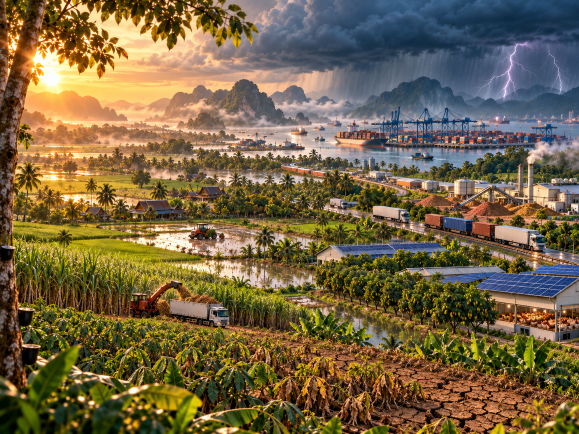
Agriculture and Food: A Trade Strength on the Frontlines of Climate Risk The agriculture and food sector provides the clearest example of both risks and opportunities. It employs nearly 30% of Thailand's workforce, and agricultural products account for roughly 14% of total export value. Furthermore, Thailand is a global leader in several commodities, including rice, sugar, rubber, cassava, fruits, and poultry products.
Because the agricultural sector accounts for 18% of the country's total greenhouse gas emissions, reducing emissions solely at the farm level may not yield significant results. If the electricity used remains high-carbon, cooling systems are inefficient, or transportation still relies heavily on fossil fuels, farm-level efforts are undermined. Therefore, a comprehensive, integrated approach is required—spanning from farm production and logistics to exporters—including a shift from burning or disposing of agricultural waste to repurposing and upcycling it.
At the same time, agriculture is one of the sectors most vulnerable to climate risks. Thailand is classified among the countries with a high risk of severe impacts from climate change over the next 30 years. This has already been evident over the past decade, as Thailand has frequently experienced extreme weather events. Consequently, climate adaptation in the agricultural sector is of paramount importance.
If yield, quality, and raw material consistency cannot be maintained, even agricultural goods with a low carbon footprint may fail to reach the market.
Adapting and Co-creating Rules: New Opportunities in the International Arena The linkage between trade and climate became even clearer following the COP30 summit in Brazil this past November 2025. Issues concerning economics, finance, trade, and actionable implementation were placed at the heart of the negotiations, alongside discussions on climate measures that could impact trade.
The upcoming COP31 in Turkey in November 2026 will serve as a crucial platform where trade discussions will take an even more definitive shape. Key issues to monitor include transition finance, adaptation investment, technological development, the creation of resilient supply chains, and the management of cross-border impacts from climate policies. These are all critical matters for Thailand.
We should utilize this period to restructure our production bases, build robust data and traceability systems, invest in climate adaptation, and elevate our farmers and SMEs. Furthermore, we must leverage our role in regional and international forums to help co-create new rules. By doing so, we can transform actions driven by environmental commitments into strategic advantages that enhance national competitiveness. Waiting for global rules to be finalized before adapting will only result in bearing increasingly higher costs.
Additionally, the Annual Meetings of the IMF and the World Bank, to be hosted in Thailand from October 12-18, 2026, present a major opportunity to advocate for greater investment in climate adaptation (Adaptation) alongside mitigation efforts (Mitigation). This will lay a solid foundation for the country's future stability.


Share: