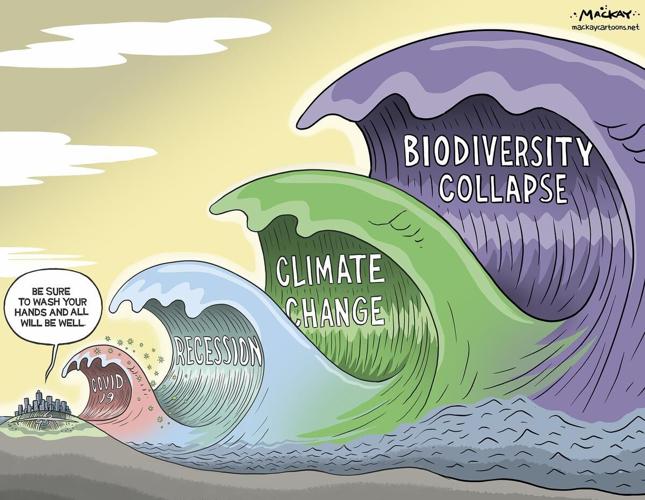
Pause and look at the world through a single image that captures the complex reality of the global environmental crisis—from public health and economic turmoil to climate change and biodiversity loss. These crises do not occur in isolation; they resemble overlapping waves, silently converging and intensifying at the same time. This reality is powerfully conveyed through a symbolic cartoon by Graeme MacKay, which has become an influential communication tool on the global stage.
This article invites readers to decode the image and connect global lessons with the Thai context, while posing a critical question: will society continue to rely on short-term fixes, or is it ready to shift its development pathway to confront the “next wave of crises” that is already on the horizon?
Later, social media users began to comment on the image, prompting MacKay to add a third wave -
climate change representing the climate crisis. Behind it, he then added the largest wave -
biodiversity collapse, symbolizing the breakdown of biodiversity. Together, these waves portray a world facing multiple crises that are converging at the same time.
Notably, the original caption from the first image “Wash your hands and everything will be fine (from COVID-19)” was left unchanged. This choice underscores a striking irony: while society focuses on short-term, immediate solutions, far larger and more persistent crises have already been advancing yet continue to be overlooked.
.jpg)
This image has since been adapted and widely used in global environmental communication. One notable example was the display of this symbolic image along the banks of the River Clyde during the 26th Conference of the Parties to the United Nations Framework Convention on Climate Change (COP26), held in late 2021 in Glasgow, Scotland. Although it wasn’t a part of the official conference proceedings, it became a powerful element of environmental movements and public demonstrations. Activists and protesters used it to convey a symbolic message about overlapping and interconnected global crises in a way that resonated strongly with the public.
.png)
MacKay’s cartoon may be not intended merely to evoke emotion; rather, it functions to “reframe the problem” by connecting crises that are often treated as separate, infectious disease outbreaks, economic recession, climate change, and biodiversity loss into a single, compounded crisis that is reshaping the global system in profound and far-reaching ways.
Around the same period, Inger Andersen, Executive Director of the United Nations Environment Programme (UNEP), introduced the concept of the Triple Planetary Crises in July 2020. This framing closely parallels MacKay’s imagery, highlighting three interlinked global crises: climate change, biodiversity loss, and pollution—each backed by strong scientific evidence confirming both their severity and urgency.
Andersen emphasized that these crises share common roots in unsustainable patterns of production and consumption. She stressed that a world facing triple, overlapping crises must redefine the relationship between humanity and the planet, moving toward an integrated and coherent approach that places environmental sustainability at the core of development.
Returning to MacKay’s image, this message is not unfamiliar to those working in Thailand’s environmental community. The image has been repeatedly cited and referenced by senior figures across various organizations to illustrate crises that have been unfolding for some time. Its widespread use in policy forums, academic conferences, and public communication reflects that the image is more than a work of art, it is a powerful tool for opening complex conversations within limited timeframes, where clarity and shared understanding are essential.
This is because, over the past few years, Thailand has faced repeated disasters ranging from flooding in the central region and the Chao Phraya River basin, to flash floods in the North, and coastal urban flooding compounded by storm surges and high tides. These events have caused extensive damage to homes, infrastructure, and economic supply chains, disproportionately affecting informal workers and low-income groups whose capacity to recover is limited.
At the same time, prolonged droughts in many areas have exposed the fragility of water management systems and the agricultural sector. Many farmers are confronting rising production costs, unstable incomes, and increasing climate variability. This is not merely an environmental issue, but one that directly affects livelihoods, migration, and the country’s overall economic stability.
These impacts do not occur in isolation; they are linked in a chain reaction from community incomes and labor migration to the growing fiscal burden on the state for relief and recovery. This clearly demonstrates that the cost of inaction or insufficient prevention is inevitably higher than long-term, systemic investment.
Past lessons show that viewing problems as a “single wave,” or relying on short-term responses, can create a false sense that risks have passed while much larger waves are quietly approaching.
This underscores that short-term measures or fragmented projects are unlikely to be sufficient unless they are connected to structural reforms in development planning, natural resource management, economic systems, and social protection mechanisms, so that the risks are not continuously borne by much of the population.
MacKay’s image has been circulated for some time, yet it remains a powerful symbolic warning—one that continues to challenge Thai society to ask a fundamental question -
how should we design our development pathway in a world where uncertainty has become the new normal?
The answer lies in steering a transition toward sustainable patterns of production and consumption, strengthening policy integration, expanding social protection, and ensuring fairness in the distribution of benefits. These elements are at the core of responding to compounded, overlapping crises and of
standing against the next wave of crises that will inevitably arrive in the years ahead.
Acknowledgements: Information and images courtesy of:
– mackaycartoon.net
– UNEP,
The Triple Planetary Crisis: Forging a New Relationship between People and the Earth
Source: TEI



Share: